What Connects a Traditional Basta to Your Modern flaunt...
comment
0 comments
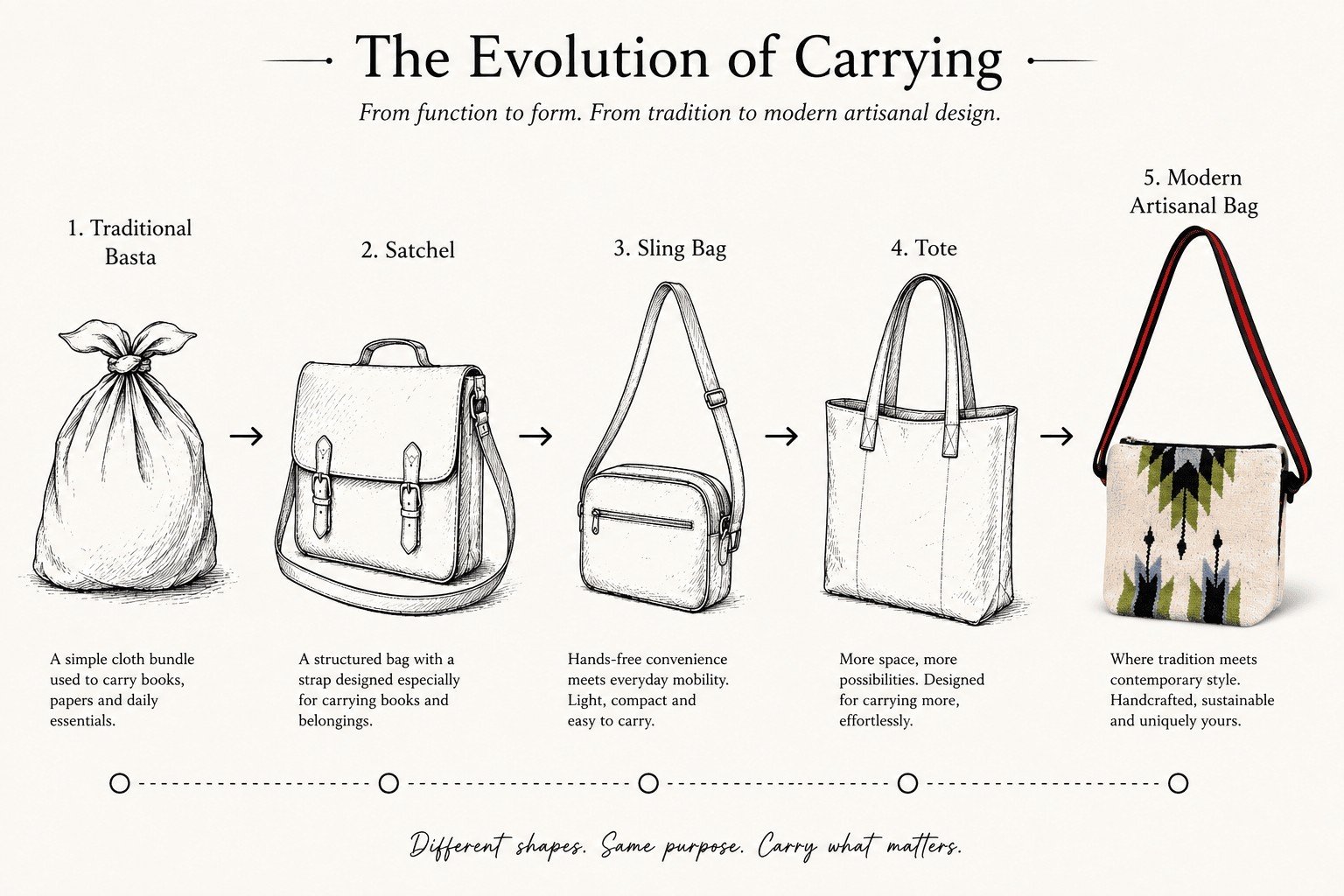


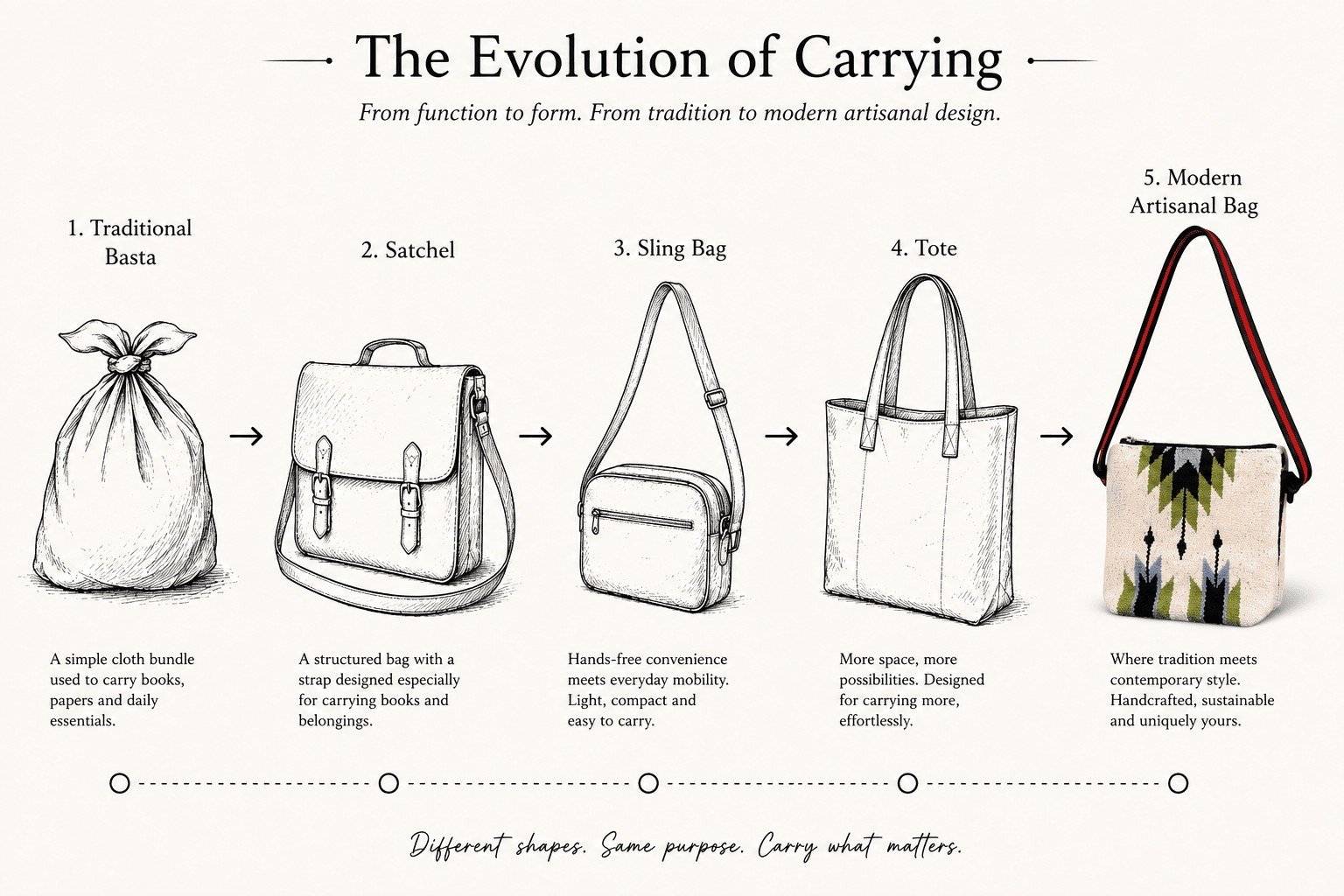
From the traditional basta to the modern artisanal bag, discover how the humble act of carrying evolved into an expression of style.
A bag is something we use every day. But long before handbags became fashion accessories, bags had a much simpler purpose: to carry, protect and organize the things that mattered.
In South Asian languages, the word “basta” has traditionally been associated with a cloth bag, bundle, wrapper or container used to carry books, papers and other belongings. Dictionaries such as Hindwi and Rekhta trace basta to Persian and include meanings such as a bag, bundle, wrapper and satchel.
The English word “satchel,” meanwhile, generally refers to a small or rectangular bag with a long shoulder strap, historically associated particularly with carrying books.
So, are a basta and a satchel the same thing?
Not quite. But their stories overlap.
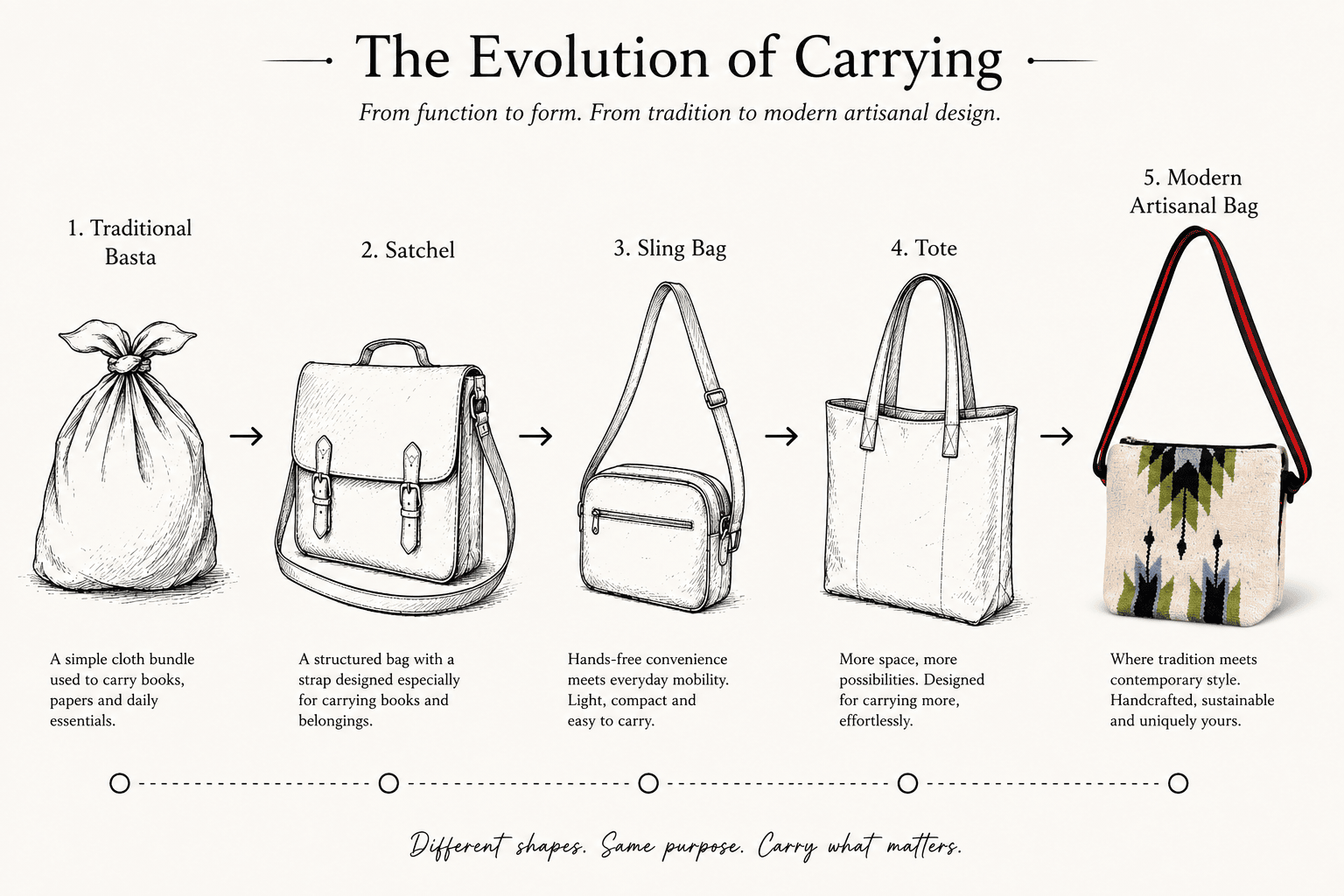
And that overlap gives us an interesting way to understand how everyday carrying evolved from simple traditional containers into today's sling bags, totes and modern artisanal bags.
The word basta has a wonderfully practical origin.
In Hindi and Urdu usage, can refer to a cloth or bag used for keeping books, papers or documents. It can also mean a bundle or something tied together.
Think of the traditional idea behind it:
Take something valuable ? wrap it ? bind it ? carry it.
There was no emphasis on branding, fashion or seasonal trends.
The primary question was simply:
How can I carry my belongings conveniently and securely?
That makes the basta less of a rigid bag "type" and more of a functional idea of gathering and carrying belongings.
And that idea is surprisingly relevant even today.

The easiest way to understand the distinction is this:
| Basta | Satchel |
|---|---|
| A traditional South Asian term | An established English bag category |
| Can refer to a cloth bag, bundle or container | Usually a defined bag with a strap |
| Historically associated with books, papers and belongings | Traditionally associated with carrying books |
| Can be relatively simple and flexible | Often rectangular or structured |
| Defined more by its function and cultural usage | Defined more by its form and construction |
A satchel is generally more specific in its physical design. Cambridge describes it as a rectangular bag with a long strap, historically used especially for carrying books.
So while every satchel can perform the carrying function associated with a basta, not every basta necessarily looks like a modern satchel.
That's an important distinction.
The traditional basta represents simplicity.
A piece of cloth could become a container. Papers could be gathered together. Books could be carried from one place to another.
The construction could be uncomplicated because the purpose was uncomplicated.
Utility came first.
This philosophy is fascinating when viewed from today's perspective because modern consumers are increasingly interested in products that aren't merely decorative.
They want products that have:
In other words, many of the values we associate with contemporary artisanal products aren't entirely new.
They were embedded in traditional making.
As carrying needs became more specialized, bags developed more recognizable forms.
The satchel is a good example.
A traditional satchel typically has a long strap and a body designed to carry books or personal belongings.
The structure makes the bag easier to organize and carry.
Instead of simply wrapping belongings together, the bag becomes a dedicated carrying system.
That is a subtle but important transition:
From container ? to designed object. And once bags became designed objects, aesthetics naturally began to matter more.
Then came another shift:
Hands-free carrying.
The shoulder strap became increasingly important.
Instead of simply carrying a bag by hand, people could sling it across the body and move freely.
This gave rise to the popularity of sling and crossbody silhouettes.
The basic principle remained remarkably familiar:
Keep your belongings close while keeping your hands free.
But the design became lighter, more mobile and more suited to everyday urban life.
Today, sling bags have become particularly popular because they combine: compact storage + mobility + personal style.
The tote takes the story in another direction.
Instead of emphasizing compactness, the tote emphasizes capacity and accessibility.
It is often open, spacious and easy to load.
Think of everything people carry today:
The humble carrying container has once again adapted to contemporary life.
The difference?
Today's tote doesn't have to be merely practical.
It can also be a statement of personal style and values.
This is where the story becomes particularly interesting.
Today's artisanal bag doesn't necessarily abandon the past.
Instead, it reinterprets it.
Traditional textiles can become contemporary silhouettes.
Handwoven fabrics can become structured bags.
Kilim-inspired patterns can move from traditional textile applications into modern accessories.
Patchwork can become a design statement.
Hand stitching can become part of the visual character of the product.
The result is something quite different from a mass-produced generic handbag.
It is a bag that carries both belongings and a story.
Modern design often looks forward.
Artisanal design frequently looks both forward and backward.
It asks:
What can we preserve?
What can we reinterpret?
What can we make relevant again?
That's why traditional textiles and handmade techniques continue to influence contemporary accessories.
A handmade bag can retain the visual language of an older craft while adopting the functionality demanded by modern lifestyles.
And that is where the modern artisanal bag finds its identity.
At Craftinence, this evolution is particularly relevant. Our approach to bags is rooted in the idea that traditional craft does not have to remain trapped in traditional forms.
Textile traditions can be reimagined as contemporary satchels, shoulder bags, totes and other everyday accessories.
The objective isn't to recreate an old basta and simply give it a modern label. It is to take the spirit of functional, handcrafted carrying traditions and reinterpret them for contemporary lifestyles.
That could mean a colourful kilim-inspired satchel for someone who wants something distinctive.
It could mean a spacious shoulder tote for everyday use. Or it could mean an artisanal bag that adds a handcrafted element to an otherwise contemporary outfit.
The answer depends on what you're talking about.
Basta is a culturally rooted word with meanings connected to a bag, bundle, wrapper or container for carrying books, papers and belongings.
Satchel is a more specific English bag category, traditionally characterized by a shoulder strap and associated with carrying books.
But both belong to a much bigger story.
A story that begins with a simple human requirement:
And continues through centuries of experimentation in materials, construction, comfort, culture and style.
From a tied bundle of belongings to a beautifully crafted contemporary handbag, the journey is not really about replacing one bag with another.
It's about reinventing the way we carry our lives.
©2026 CRAFTINENCE INDIA | All rights reserved


